
When to Seek Gallbladder Stone Treatment
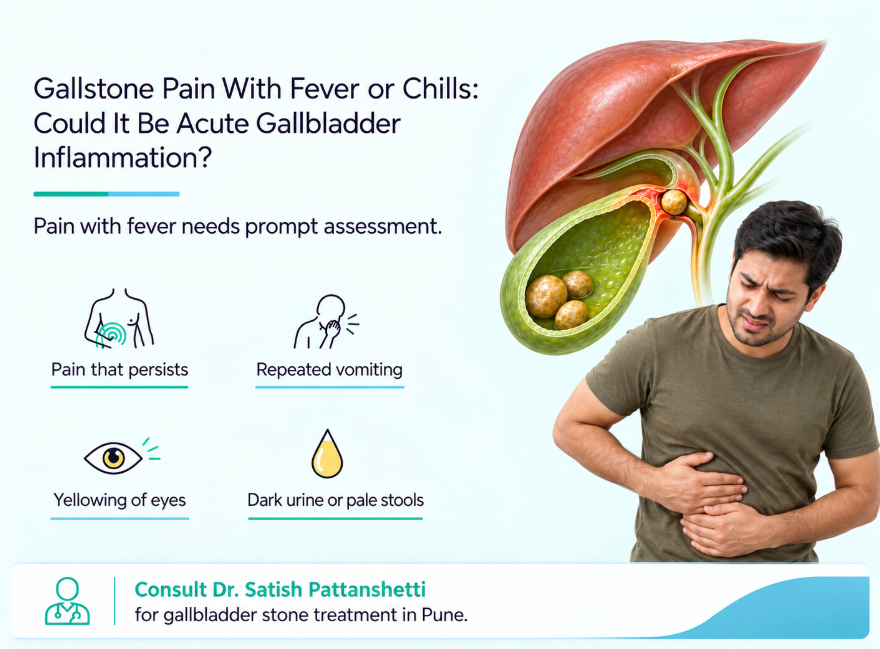
Gallstone pain by itself can be intense, but pain accompanied by fever or chills is more concerning. It may indicate acute cholecystitis, an inflammation of the gallbladder that commonly develops when a stone remains lodged at the gallbladder outlet.
This condition should not be managed only with home remedies or painkillers. Persistent upper abdominal pain, fever, repeated vomiting, or jaundice requires prompt medical assessment. Timely gallbladder stone treatment may prevent progression to infection, tissue damage, or other complications.
What Is Acute Cholecystitis?
The gallbladder stores bile produced by the liver. When food enters the intestine, particularly a meal containing fat, the gallbladder contracts and releases bile through small ducts.
If a gallstone blocks the cystic duct, bile becomes trapped. Pressure and chemical irritation can inflame the gallbladder wall. Bacterial infection may develop in some cases, but inflammation can be significant even before infection is confirmed.
Unlike uncomplicated biliary colic, in which temporary blockage settles, acute cholecystitis usually causes persistent pain and tenderness. The condition requires clinical examination, blood tests, and imaging.
How Is It Different From an Ordinary Gallbladder Attack?
Biliary colic often causes steady pain in the upper-right or upper-middle abdomen after a stone temporarily blocks bile flow. The pain may spread to the back or right shoulder and commonly resolves within a few hours when the obstruction clears.
Acute cholecystitis is more likely when pain does not settle, the abdomen becomes tender, and systemic symptoms such as fever or chills appear. Deep breathing may worsen the pain because the inflamed gallbladder moves near the examining hand and diaphragm.
The NIDDK advises immediate medical care when a gallbladder attack is accompanied by pain lasting several hours, nausea and vomiting, fever or chills, jaundice, tea-coloured urine, or light-coloured stool.
Warning Signs That Need Urgent Assessment
- Persistent or worsening pain beneath the right ribs
- Fever, chills, sweating, or feeling severely unwell
- Repeated vomiting or inability to keep fluids down
- Yellowing of the eyes or skin
- Dark urine or pale stools
- A swollen, rigid, or increasingly tender abdomen
- Confusion, faintness, breathing difficulty, or a rapid heartbeat
These symptoms can reflect acute cholecystitis, bile duct infection, pancreatitis, or another urgent abdominal condition. Chest pain or breathlessness must also be assessed because heart and lung disorders can produce overlapping symptoms.
Could Fever Mean a Bile Duct Infection?
Yes. If a stone passes from the gallbladder into the common bile duct, it may obstruct drainage from the liver. Pain with fever and jaundice raises concern for acute cholangitis, an infection of the bile ducts that can become life-threatening without urgent treatment.
A common bile duct stone can also block the pancreatic opening and trigger acute pancreatitis. The NIDDK pancreatitis guidance describes severe upper abdominal pain that may spread to the back, together with nausea, vomiting, fever, or a fast heartbeat.
The exact cause cannot be determined safely from symptoms alone.
How Is Acute Gallbladder Inflammation Diagnosed?
The doctor will examine the abdomen and review the timing and location of pain, meal triggers, vomiting, fever, jaundice, medicines, and previous attacks. Blood tests may show inflammation and may assess bilirubin, liver enzymes, kidney function, and pancreatic enzymes.
Ultrasound is commonly the first imaging test. It can identify gallstones, thickening of the gallbladder wall, fluid around the gallbladder, and widening of the bile ducts. If findings are uncertain or a duct stone is suspected, MRCP, CT, endoscopic ultrasound, or a nuclear medicine scan may be considered.
A diagnosis should combine symptoms, examination, laboratory results, and imaging rather than rely on one ultrasound feature alone.
What Treatment May Be Needed?
Hospital treatment may include fasting for a period, intravenous fluid, pain relief, anti-nausea medicine, and antibiotics when infection is suspected. The definitive treatment for acute calculous cholecystitis is usually laparoscopic cholecystectomy, in which the gallbladder is removed through small incisions.
The 2020 World Society of Emergency Surgery guidelines recommend early laparoscopic cholecystectomy as the standard approach whenever it is feasible, including careful assessment of patients with additional health risks.
If a stone is present in the common bile duct, ERCP may be used to remove it. Patients who are temporarily too unwell for surgery may need gallbladder drainage or another tailored plan.
Why Not Wait for the Fever to Settle?
Pain and fever may fluctuate after medicine, but temporary improvement does not prove the obstruction or inflammation has resolved. Delayed treatment can allow the gallbladder to develop pus, tissue death, perforation, or infection spreading into the bloodstream.
Do not apply pressure over a severely tender abdomen, take leftover antibiotics, or repeatedly suppress worsening symptoms without medical advice. A person who is faint, confused, breathless, jaundiced, or unable to drink should be taken for emergency care.
Frequently Asked Questions
- Does every fever during a gallstone attack mean acute cholecystitis?
No. Fever can have other causes, but fever or chills with upper abdominal pain is a warning sign that needs prompt assessment. Acute cholecystitis, bile duct infection, pancreatitis, and unrelated infections must be considered.
- Can acute cholecystitis improve without surgery?
Symptoms may improve temporarily with fluids, pain relief, and antibiotics, but gallstones remain and attacks can recur. Surgery is usually the definitive treatment when the patient is suitable. Timing depends on severity, test results, and overall health.
- Is gallbladder surgery safe during active inflammation?
For many appropriately assessed patients, early laparoscopic surgery is recommended during the same episode. Individual risk varies, so the surgeon and anaesthesia team consider inflammation severity, organ function, medicines, and other medical conditions.
Consult Dr. Satish Pattanshetti for Gallbladder Stone Treatment in Pune
Gallstone pain with fever or chills should be taken seriously, especially when pain persists or jaundice and vomiting develop. Dr. Satish Pattanshetti provides surgical evaluation and treatment planning for patients seeking gallbladder stone treatment in Pune. Prompt assessment can distinguish a temporary attack from acute inflammation or bile duct complications.
This article is for general education and should not delay emergency medical care when warning symptoms are present.
#gallstones #acutecholecystitis #gallbladderhealth #gallstonetreatment #laparoscopicsurgery #digestivehealth #punehealthcare