
Understanding Recurrence and Hernia Treatment
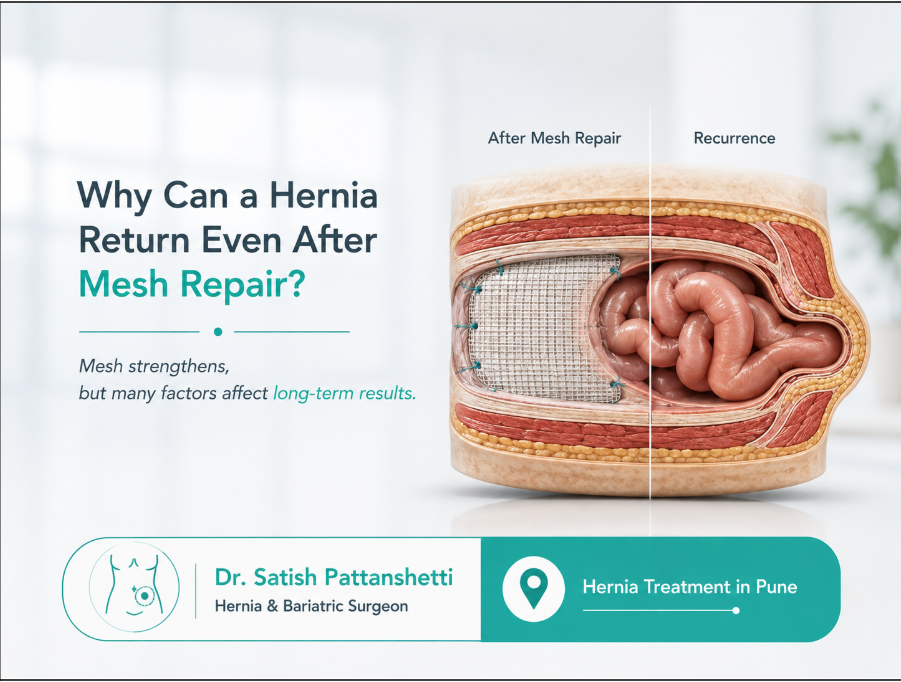
Mesh repair lowers the chance of many hernias returning, but it cannot make recurrence impossible. A hernia forms when tissue pushes through a weak area in the abdominal wall. Surgery closes or reconstructs that weakness, and mesh can reinforce the repair. The result still depends on tissue quality, defect size, healing, pressure inside the abdomen and the technique used.
A new lump after surgery should be assessed rather than labelled immediately as a failed mesh. It could be a recurrent hernia, fluid collection, scar tissue or a different nearby defect. Patients considering further hernia treatment in Pune need an examination and appropriate imaging before decisions are made.
How Mesh Helps, and What It Cannot Do
Mesh spreads tension across a wider area than stitches alone and allows tissue to grow into or around the reinforcement. The European Hernia Society’s midline incisional hernia guideline reports a lower recurrence risk with mesh than with suture repair for appropriate incisional hernias.
However, mesh does not replace living tissue. The abdominal wall continues to experience coughing, lifting, weight changes and normal movement. If overlap is inadequate, fixation fails, the original defect remains under high tension or tissue healing is poor, a gap can develop at the edge or within the repair.
Recurrence may also represent a new hernia beside the previous repair rather than failure at exactly the same point. Operative records and imaging help clarify the anatomy.
Factors That Increase Recurrence Risk
Risk is influenced by the hernia and by the patient’s health. Important factors include:
A large or complex defect, multiple previous repairs or poor quality scar tissue
Obesity, smoking, uncontrolled diabetes, malnutrition or medicines that suppress immunity
Wound infection, chronic cough, constipation, urinary straining or fluid accumulation in the abdomen
The European Hernia Society identifies obesity as a recurrence risk factor after incisional hernia repair and advises attention to modifiable risks such as smoking and diabetes. These factors do not mean surgery will fail, but optimising them may improve wound healing and long term durability.
Some pressure is unavoidable. The objective is not to prevent every cough or movement, but to control persistent drivers and follow recovery instructions while tissue is healing.
The Role of Surgical Planning
Hernias differ in location, width, contents, previous mesh position and loss of abdominal wall function. A small primary umbilical hernia is not planned in the same way as a large recurrent incisional hernia.
The surgeon may use ultrasound or CT to map the defect and surrounding muscles. For selected ventral hernias, closing the fascial gap and placing mesh in a well vascularised plane can restore the abdominal wall more effectively than simply bridging a large opening. Complex cases may need myofascial release or abdominal wall reconstruction.
Open, laparoscopic and robotic approaches each have advantages in specific situations. The best approach is the one that fits the anatomy, previous operations, contamination risk and surgeon’s expertise. Technology alone does not guarantee a recurrence free result.
Is Every Postoperative Bulge a Recurrence?
No. A seroma, which is a collection of clear fluid, can create a soft bulge after repair. Swelling, haematoma and scar tissue can also change the contour. Some patients have rectus diastasis, a widening between the central abdominal muscles that may look like a hernia but is not a true hole in the fascia.
A recurrent hernia may become more noticeable when standing, coughing or straining and may reduce when lying down. These signs are helpful but not conclusive. Examination and imaging may be needed, especially after a large repair.
Sudden severe pain, vomiting, abdominal swelling or a firm lump that cannot be pushed back requires urgent assessment because bowel obstruction or strangulation is possible.
Can Recurrence Be Prevented?
No strategy removes all risk, but several steps may help:
Stop smoking and improve glucose control and nutrition before elective surgery
Work toward a safer weight when feasible without delaying urgent treatment
Treat persistent cough, constipation and urinary obstruction, and follow lifting advice during recovery
Patients should not remain inactive for months. Early walking is usually encouraged, and activity is increased according to the surgeon’s plan. Blanket restrictions can weaken the body, while premature heavy strain may stress healing tissue. The advice should match the operation.
What Happens if a Hernia Returns?
Management depends on symptoms, size, progression and risk. A small, minimally symptomatic recurrence may sometimes be monitored. Pain, increasing size, difficulty reducing the lump, bowel symptoms or impaired daily activity may support another repair.
Recurrent surgery requires careful review of previous reports, mesh location and infection history. The surgeon may need to remove mesh only if it is infected, exposed or creating a specific problem. Routine removal of well incorporated mesh is not always necessary and can cause additional tissue damage.
Consult Dr. Satish Pattanshetti for Hernia Treatment in Pune
Dr. Satish Pattanshetti evaluates primary and recurrent abdominal wall hernias using clinical examination and imaging when required. Patients seeking hernia treatment in Pune can receive an individual plan that addresses defect anatomy, previous repair, health risks and the most suitable surgical approach.
Frequently Asked Questions
- How soon can a hernia return after mesh repair?
Recurrence can become apparent within months or many years later. Early recurrence may relate to healing or technical factors, while later recurrence can reflect ongoing tissue weakness, weight change or chronic abdominal pressure.
- Does a recurrent hernia always need another operation?
No. Treatment depends on pain, size, progression, bowel risk and effect on daily life. Observation can be reasonable for selected low risk cases, but urgent symptoms require immediate care.
- Will the old mesh have to be removed?
Not always. Existing mesh may be left in place if it is well incorporated and not infected or causing symptoms. Removal is a case specific decision based on imaging and operative findings.
#herniatreatmentinpune #recurrenthernia #meshrepair #abdominalwallrepair #herniasurgery #drsatishpattanshetti